A Soundwalk for Klangspuren Festival 2025 https://klangspuren.at/
Now you hear it! Now you don´t! – IBK – invites you to explore urban spaces through sound, where sound is not just an acoustic phenomenon but a key element of how we perceive places. The path takes you through both outdoor and covered areas, revealing how space and sound are closely connected. Soundscapes and spaces influence each other, opening new ways to experience the city beyond the visual.
Date: 22.09.25 – 18:00
Start and End: Cubus Landestheater
Duration: approx. 60/80 minutes
Route length: 2.1 km
Sound Map of the Soundwalk – enjoy listening
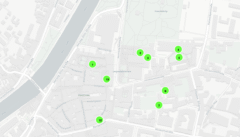
1_Time Sound
From a distance, the carillon of St. Jakob’s Cathedral rings out, linking the historical sound dimension with the urban sounds of the present, making the encounter of past and present perceptible. A modern water feature adds a constant noise over the square. In the near field, footsteps, voices, and a barking dog shape the scene—the latter activates the acoustics, making reflections on stone surfaces and buildings audible.
Listen on radio aporee:https://aporee.org/maps/work/?loc=69570
2_Acoustic Disappointment
The modern water feature produces a uniform, constant noise, more reminiscent of a ventilation system, partially masking the sound events of the square. Typical water sounds—dripping, gurgling, or gentle splashing—are absent, so the expected liveliness of the water is missing. Clearly, visual aspects were prioritized in its design.
Listen on radio aporee:https://aporee.org/maps/work/?loc=69571
3_Instrument in G
In the passageway, reflections from the ceiling, floor, and walls create a flutter echo that modulates all sounds in the space. Certain frequencies resonate and are thus amplified, so that a simple clap takes on a tonal character — here approximately a G. In this way, the space transforms into an acoustic instrument that visitors can explore playfully.
Listen on radio aporee:https://aporee.org/maps/work/?loc=69573
4_Sound Volume
The acoustics of the large foyer and adjoining corridors (Campus SOWI) arise from the volume, shape, and hard surfaces of concrete, stone, and glass, which produce a long reverberation. Voices, footsteps, and the opening of doors are amplified by the long reverberation and therefore remain audible in the space for a longer duration, so that hardly any sound event remains private.Vending machines provide a constant hum, coloring the acoustic character of the space.
Listen on radio aporee:https://aporee.org/maps/work/?loc=69574
5_Soprano in the Courtyard
The university courtyard acts like a natural amplifier: reflections enhance sounds such as loading and unloading activities from cafés, restaurants, the theater, and the university. At the same time, the courtyard shields street noise, and the lawn invites students to linger. Occasionally, a soprano from the theater can be heard, her voice gaining presence through the reflections and bringing a musical liveliness to the courtyard.
Listen on radio aporee:https://aporee.org/maps/work/?loc=69575
6_Sound Niche
When passing through the small passage from the busy Universitätsstraße, one suddenly enters a sonically intimate space. Birdsong, human voices, footsteps, and the ringing of the Jesuit Church bell shape the soundscape, creating an idyllic atmosphere and directing attention to the present moment.
Listen on radio aporee:https://aporee.org/maps/work/?loc=69576
7_Cheerful Courtyard
Sheltered from the heavy traffic of the city center, an open, acoustically protected space emerges here. Across the large lawn, children’s voices, laughter, and play carry, filling the area with joyful liveliness. The lawn dampens sounds and reduces reflections. From a distance, the constant hum of a ventilation system can be heard, occasionally complemented by the call of a falcon.
Listen on radio aporee: https://aporee.org/maps/work/?loc=69578
8_Electric Sound Square
Beneath a metal grate embedded in the stone floor lies a ventilation system whose hum is generated by European mains electricity at 50 Hz. Through resonances and overtones, this low-frequency sound is amplified and shaped. The sound colors the acoustic environment of the square and modulates all other sound events in its surroundings.
Listen on radio aporee:https://aporee.org/maps/work/?loc=69579
9_Tourist Flows
On the busy Maria-Theresien-Straße, the near field is most acoustically perceptible. Footsteps, voices in various languages, rolling suitcases, and the bustle of intense tourism converge into a dynamic soundscape typical of the city center.
Listen on radio aporee: https://aporee.org/maps/work/?loc=69580
10_Acoustic Norm
Footsteps, voices, and background music (Muzak) merge in the Rathaus Passage into a dynamic soundscape. Hard floors, glass, and metal create a long reverberation, which is, however, dampened by shop fittings and carpeted surfaces. While shopping malls have their own sound signature, they follow a standardized acoustic concept and sound remarkably similar worldwide.
Listen on radio aporee:https://aporee.org/maps/work/?loc=69581
11_Play and Listening Space
The traffic-calmed Adolf-Pichler-Platz in the city center is characterized by children’s voices, footsteps, and the soft murmur of passersby. The street runs around the square, so the sound of cars creates a slow movement, reflected by the surrounding residential buildings and amplified through resonances.
Listen on radio aporee:https://aporee.org/maps/work/?loc=69582
12_Auditory Identity
Narrow alleys, small squares, passageways, and arcades, along with stone surfaces, define the soundscape of the Old Town, giving it the characteristic fundamental sound of the Middle Ages (stone). The space is shaped primarily by the many tourists and the associated infrastructure (restaurants, cafés, souvenir shops, stores) and is located in a car-free area of the city center. The medieval architecture and irregularly laid-out streets give the space a strong auditory identity.
Listen on radio aporee:https://aporee.org/maps/work/?loc=69583
13_Retreat
Stepping out of the busy, narrow streets of the Old Town into the courtyard of the Hofburg, one enters a spacious, quiet soundscape, shaped primarily by reflections on the stone surfaces. The courtyard is mainly designed in the Rococo style. The relaxed atmosphere arises particularly from the strong contrast to the bustling Old Town, making the courtyard perceived as a retreat.
Listen on radio aporee:https://aporee.org/maps/work/?loc=69584