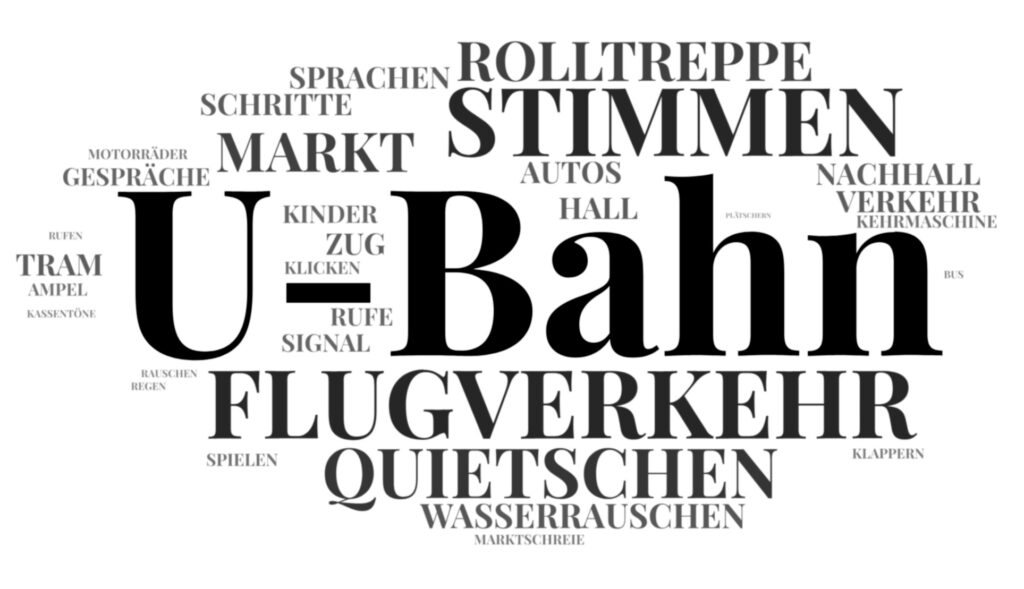
The Wiener Platz is a dynamic and dense urban sonic space. Sounds move through it, overlap, grow louder and quieter, stretch and contract in time, emerge and disappear again. Trams, the underground, traffic, aircraft, the market, the shopping passage, the playground, voices and machines form an ever-changing acoustic environment.
These changes follow different temporal and spatial structures. Timetables, traffic lights, opening hours, machine cycles and everyday movements generate recurring rhythms. The seasons and the weather alter the conditions under which these rhythms become audible. Some are immediate and brief: the clicking of a traffic light, footsteps, the clatter of an escalator. Others extend across the square and return at longer intervals. Trams and road traffic build up and release the density of the sonic space, while air traffic forms a slower, large-scale vertical layer above it.
The underground lines 18/13 are particularly present. The trains remain hidden beneath the surface, while their sound emerges at many points across the square. Through entrances, shafts, stairways, escalators and passages, the movement of the underground enters the sonic space above ground. A sound can originate in one place and reappear somewhere else, at a distance. Near and far are therefore not determined by visible space alone.
The sound map brings together different listening locations and temporal states of Wiener Platz. The recordings do not simply document what can be heard at a particular place. Their selection, repetition and spatial arrangement form a composition of different rhythms and sonic layers, making audible how they connect, overlap and change, and how temporary sonic territories emerge through different forms of use.
Wiener Platz thus emerges as a system of temporal and spatial processes. Its acoustic character is shaped by infrastructure, architecture, movement, human activity, the seasons and the weather — and by the sounds generated through their interaction.