Resonance IBK is a spatial sound composition for electric bass, electronics, field recordings, four trombones and the factory space.
Commissioned by Klangspuren Schwaz, supported by the BMWKMS
Hannes Strobl – Concept, Composition, Electric Bass, E-Upright Bass, Field Recording
Christof Dienz – Interludes for Brass
Students of the Tyrolean State Conservatory:
Finn Eberhard, Marc-Anton Allmaier, Moritz Werth, Tobias Baumann: Trombone
Excerpts from 5 Parts
SOUND MATERIAL
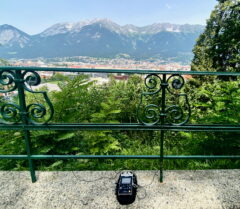
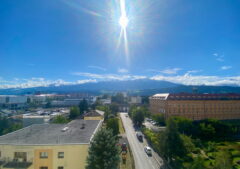
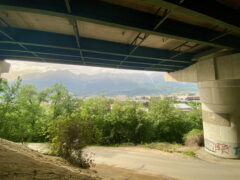
Field recordings from both sides of Innsbruck, captured simultaneously, serve as the foundation for the composition
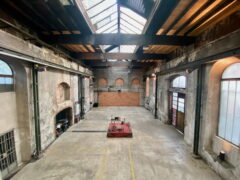
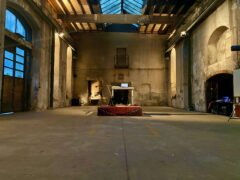
THE SPACE
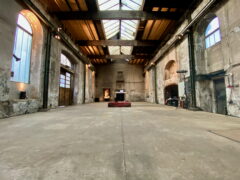
The sound material is shaped by the architecture of the former textile factory, playing a key role in the spatial composition.
ELECTRIC BASS
Field recordings merge with electronic bass
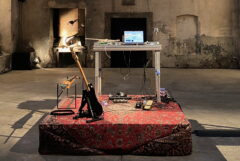
The composition Resonance IBK is based on field recordings from acoustic spaces in Innsbruck, which are understood as a structuring sonic source. The sound environment is thereby established as a formative foundation of musical perception.
From the sonic parameters of the recordings—microtonal structures, spectral profiles, and rhythmic organizations—the musical material is derived and further developed for electric bass, electric double bass, and electronic processing. The composition unfolds consistently from the recorded sound space itself.
The work is divided into five acoustic spaces that model different sonic situations in Innsbruck: railway corridor, Inntal motorway, city center, valley sides based on simultaneous recordings from both sides of the Inn valley, and the lower mountain range with the characteristic föhn wind. Between the sections, interludes for four trombones function as a connecting layer.
These spaces are not used illustratively, but understood as compositional fields whose specific acoustic properties determine the structure of the respective sections. The topographical situation of Innsbruck, situated between high mountain ranges, fundamentally shapes these soundscapes. In particular, the Inntal motorway (A12) forms a continuous acoustic layer whose sound propagation affects the entire valley space up to altitudes of approximately 2000 meters and enters the compositional perception as a permanent background layer.
This acoustic presence is actively integrated into the composition, performed in the former factory hall, St. Bartlmä, in Innsbruck. Located by the Sill River and the A12 highway, the hall becomes a resonant space where the music merges with both live sounds and field recordings from the surroundings. The architectural characteristics—shape, size, and material—define the room’s acoustic properties, making the space itself a crucial element of the composition. Sound waves interact with the room, creating resonances, reflections, and dampening effects, shaping and modulating the sonic experience.
Special thanks to the work of tamtam (Sam Auinger / Hannes Strobl), without which this composition would not have been possible.